 Brandon Pearce
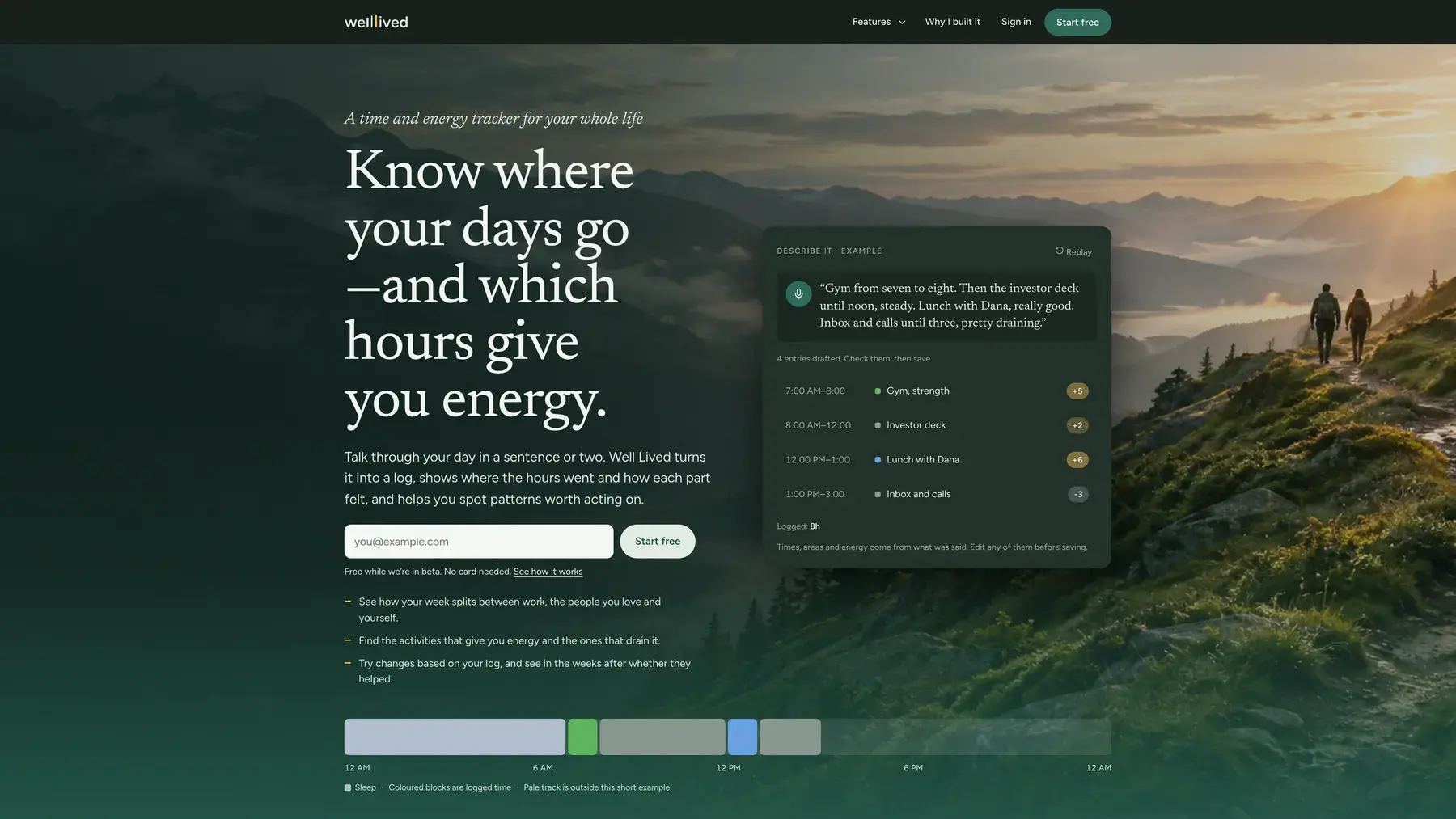
In September, I wrote about tracking every minute of my life for nine years, first in spreadsheets and then in an app I built for myself with AI. I ended that post with a question: should I turn it into a product?
A few of you replied that you'd like to try it. That was enough for me to start building it into a beta program.
It's called Well Lived, and anyone can now sign up at welllived.io. It's free while it's in beta.
What it's for
I've been building Well Lived and using it for the past several months to:
- Get more insight into how I'm spending my time during my day
- Gain greater awareness of how that's affecting me
- Give me time to reflect
- Coach me toward living my life more according to my values and goals, and in the balance I want for each area of my life
The spreadsheets did some of this for nine years. The app makes it much easier. And the AI in it finds correlations between different areas of my life that I missed in the spreadsheets, which helps me make informed changes.
Why "Well Lived"
I've always been about living well and enjoying life now. For years, I ended each of my videos with the same line: "Live well and enjoy life now."
Socrates said the unexamined life is not worth living. Well Lived is about how to live your life well, and I believe that takes examining it. So the tagline became The examined life, well lived.
What it's changed for me
For a few months, my balance report kept showing my social life under the goal I'd set for it. I work from home, so I wasn't surprised. But seeing it on the chart week after week is what got me to do something about it.
So I started going to events. I volunteered at Tech Week Greenville and met some great people in the community. And my family and I started CommuniTree, a free community song circle that meets in our living room on Thursday evenings. I wrote about how that came about in Singing Together Again.
Our first circle was on October 22, and it was really fun and fulfilling. It feels good to sing and connect with more people. I've enjoyed writing songs for it, too.
The same thing happened with exercise. The app made it obvious that one strength session a week wasn't enough for my longevity goals, so I added a second one at home on weekends.
Neither change was complicated. I just couldn't ignore what I was seeing.
The first product like this since 2004
It's been a long time since I've launched a product I care about and believe in this much.
In 2004, I was teaching piano and built a web app to keep track of my students. That became Music Teacher's Helper, my first software business, and the one that eventually funded our family's eleven years of travel.
Most of what I've worked on lately are businesses I bought, like HelpSite and UniHop, because I saw a good opportunity to improve and grow a system, or to improve the design. That's something I'm good at, and I enjoy it.
Well Lived is different. I use it every day, all throughout the day, and it's had a positive impact on my life. It reminds me of how Music Teacher's Helper felt in those early years, and I've missed that feeling.
Every week that I use it, I find new things I want to improve, and ways to make it more effective. I'm also looking forward to hearing what other people would like to see in it.
Why I built my own
There are a lot of apps out there for tracking your time, though mostly in a work context, or only what you do on your devices. There are also a lot of apps for tracking your fitness and health, like the ones that come with your ring or watch.
I couldn't find one that takes the data from all of them, adds every other area of your life and your time, including offline, and puts it into one system that's easy to read and understand. One that gives you a better sense of what you're doing and where you're headed, and shows you which small changes would make the most difference.
So I built it.
Is this just an obsession?
I know tracking every minute of your life sounds a little extreme. I've wondered myself whether it's useful or just a quirk of mine. So I looked at what researchers have found about the pieces of it.
- Tracking progress helps you reach goals. A 2016 review of 138 experiments found that people who monitored their progress toward a goal were more likely to reach it, and the effect was larger when they physically recorded their progress or reported it to someone. (American Psychological Association)
- Writing it down changes what you do. In a Kaiser Permanente study of nearly 1,700 people trying to lose weight, those who kept daily food records lost twice as much as those who kept none. (ScienceDaily)
- Reflection makes experience count. In a field study with new employees at a large outsourcing company, the ones who spent the last 15 minutes of each training day writing about what they'd learned did 23% better on the final test. (HEC Paris)
- Relationships affect how long you live. A review of 148 studies covering more than 300,000 people found that those with stronger social relationships had a 50% greater likelihood of survival over the study periods. (PLOS Medicine)
I learned a small version of the food-diary finding in a junior high health class, when I had to write down everything I ate for a week. Having to log the candy made me pause before eating it, and I ate less of it.
Time works the same way. If you know you'll be writing down "scrolled social media, 1h 30m," you're a lot less likely to spend that hour scrolling.
None of these studies tested Well Lived, of course. But they suggest that noticing what you do, writing it down, and reflecting on it are worth a few minutes a day. That's the habit the app is built around.
What it tracks
Time is the center of it. Each entry starts where the last one ended, so your day adds up without a timer running, and you can rate how each part of it felt, from drained to energized.
Then you turn on whichever of these you care about:
- Direction: goals, monthly priorities, a bucket list, your values, and your balance across the areas of your life
- Body and health: sleep and heart rate from an Oura Ring, Fitbit, or Pixel Watch, meals (take a photo and it estimates the calories, protein, carbs, fat, sugar, fiber, and more), workouts, lab results, and health issues
- People: how much time you spend with each person and what you do together, and a reminder when you're due to reach out
- Life: highlights, books, movies and shows, dreams, and a private intimacy tracker
Everything lands on the hour it happened, so you can see how your meals line up with your energy, or your evenings with your sleep.
You can also connect it to Claude or ChatGPT and ask about your own life in plain words, like "What do my highest-energy days have in common?" or "How does my sleep change after evenings I work late?"
Morning, evening, and week
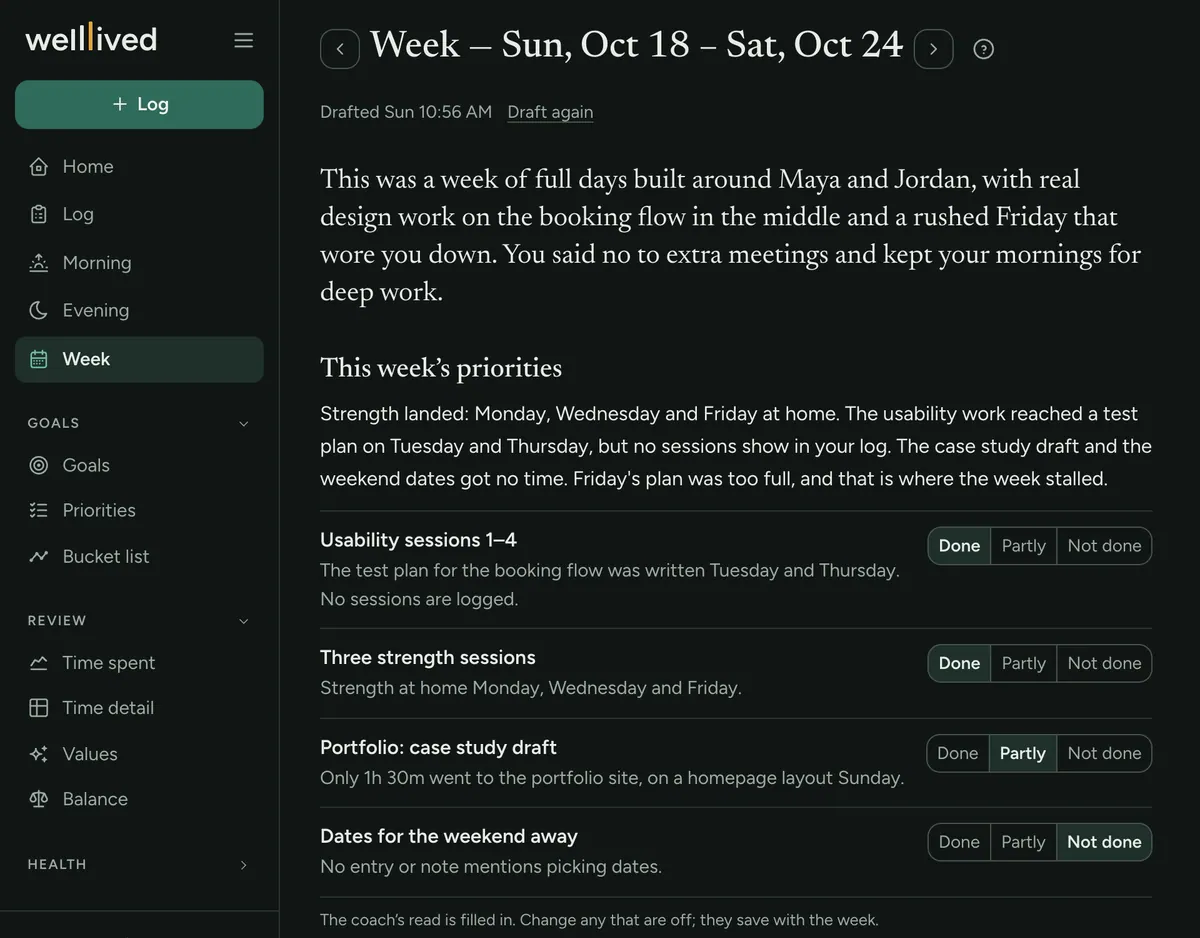
Besides the log, there's a page for the morning, one for the evening, and one for a weekly review. They give you a chance to:
- Write your thoughts and the things you're grateful for
- Plan your priorities for the day
- Assess how you did each day at living your values and goals, and at getting done what you set out to do
Over time, the AI coach notices patterns in your behavior and suggests changes, along with some encouragement, to help you reach your goals. Each week it writes a short review with highlights, a correlation you might have missed, and something to try in the week ahead.
How to start
It's free during the beta, with no card to enter, and beta members will get a discounted rate when paid plans start. If you'd like to try it:
- Start logging some of your time.
- Connect your ring or watch, if you have one.
- Set a few goals.
Then give it a week or two, and see what awareness you gain about how you're spending your life, and how you want to be spending it.
Tips for building the habit
The hardest part for most people is building the habit of logging. I've heard that from the people already using it, and I've worked on making it easier.
Talk to it. You don't have to type everything. Tap the microphone and describe what you did over the past few hours. Well Lived breaks it down into projects and activities for you, and even senses your energy level. You can adjust any of it before you save.
Turn on reminders. Well Lived can remind you to log, and send a morning nudge if you haven't started your day. There's no app in the App Store or Google Play yet, but you can add it to your phone's home screen and it works much like one. On a phone, add it to your home screen first, then turn on notifications in Settings. On a computer, allow notifications when your browser asks.
Pick a rhythm that fits. I've gotten in the habit of taking a few moments to reflect every time I switch tasks, so I can log what I just did. You can also set an hourly timer and take a few seconds to say what you did in the past hour. Every few hours works too.
Keep mornings rough. When you wake up, give a general time for when you went to bed and got up, and about how long you showered or exercised. If you have an Oura Ring or Fitbit, it fills in your sleep for you.
Don't let the setup intimidate you. If you're not sure what your life areas, values, or goals are, that's okay. The app guides you through choosing some, and you can change them anytime. If it does feel like too much, please tell me. I want to keep improving the first few days so it's as easy as possible to get going and to build a habit of not just tracking but reflecting on your time.
How you can help
I still have a list of dozens of improvements I want to make and ideas I'm considering. But it's good enough to launch, and I'm excited to get feedback and watch it grow.
Marketing is the hardest part for me. I'm also running three other businesses, so my time for it is limited, and I'd appreciate any help spreading the word.
- Try it for a week or two. Sign up at welllived.io and log a few days.
- Tell me what you think. The best way is Send feedback in the app's account menu, which comes straight to me. You can also send me a note here. I especially want to hear what confused you and what you wish it did.
- Share it. If you know someone who journals, wears an Oura Ring, tracks their workouts, or keeps wondering where their week went, send them this post or welllived.io. In the app, Invite a friend in the account menu gives you a link to send. It's free for them during the beta, and when paid plans start, you'll get a free month for each friend who becomes a paying member.
This launch is a big thing for me right now, and every person you send its way helps.
Invitation
Which part of your week do you think gives you the most energy, and which part drains you the most? How sure are you?
Pair This Post With…
Book
- Four Thousand Weeks: Time Management for Mortals by Oliver Burkeman — The average human life is about four thousand weeks long. Burkeman's case is that you'll never get it all done, so what matters is choosing which few things get your weeks, and paying attention while you're in them.