Returning to the Medicine
I first sat with ayahuasca in 2015, during a three‑day retreat in Spain. I described the experience as beautiful, difficult, revealing, and perfect.
What stayed with me wasn’t just the intensity of the medicine itself, but the clarity that persisted: seeing some of the ways I held myself back, noticing patterns like approval‑seeking and self‑judgment, and remembering how important it is to stay present with the people I love.
It also helped me reconnect with a desire to live more honestly and more fully.
Over time, those insights became a quiet reference point for how I wanted to show up in my life. And after nearly a decade, I felt called to return this past summer, from a different place in myself. And this time, my wife Jen joined me.
Choosing a Different Path This Time
My first retreat had a more modern, psychotherapy‑oriented feel. This time, we intentionally chose a more traditional path with ceremonies led by Shipibo shamans from Peru, a lineage that felt both ancient and deeply intentional.
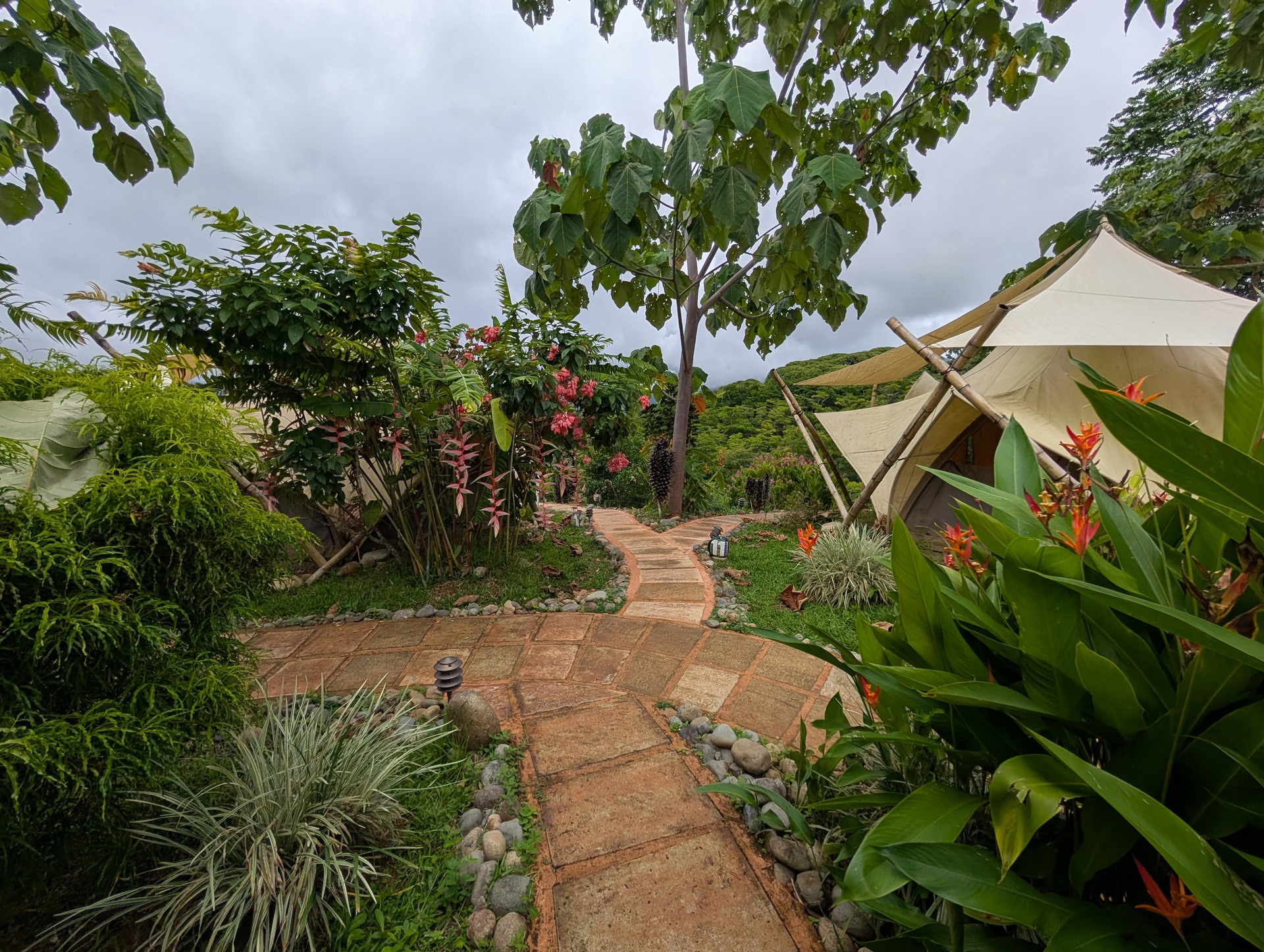
The retreat itself was run by Soltara in Costa Rica — glamping tents, shared bathrooms, a beautiful waterfall in the distance, and open bamboo structures for eating and gathering, with the sounds and smells of nature accompanying all our activities. The facilitators carried the space with kindness and integrity that made it easy to relax into the experience.
Preparation as Part of the Ceremony
The preparation itself became part of the medicine. For weeks beforehand, we followed a strict "dieta," including (among many other things) no sugar, salt, caffeine, peanuts, dairy, most oils, most meats, and no sex with self or others.
A few days into the diet, my body began feeling lighter — clearer, quieter, and more aware — and it started bringing up things I needed to look at and work through.
What Stayed With Me
One of the main things ayahuasca seems to teach is how to become more comfortable with discomfort — not by pushing through it, but by softening into whatever’s actually happening.
I won’t go into every detail of the ceremonies, but a few things stayed with me:
- The difference between believing I’m okay and actually feeling it in my body.
- How much of life unfolds naturally from conditioning—mine and everyone else’s—and how understandable that is (no need to judge it).
- The reminder that I can learn to stay present with someone’s emotions without absorbing them.
- The clarity that desires don’t need to be shamed or indulged; they can simply be noticed.
- And the simplest: being content with what I have, right here, not in some imagined future.
Those were the ideas.
The practice came later.
The Day Everything Went Wrong
The morning after the retreat ended, we had breakfast with the group, said our goodbyes, and rode the shuttle back toward San José. Everything felt light. Unhurried. From here, Jen and I had planned an extra week to travel around Costa Rica together.
Then we picked up our rental car. That’s when the chain reaction began.
The car didn’t support Android Auto, only a specific "Car Link" app I had to download for maps. My USB cable needed an adaptor, the connection kept failing, and I finally got it working long enough (glitchingly) to drive to an ATM — where I immediately selected the wrong option and got an error message.
After calling the bank to sort it out, I walked back to the car only to discover my phone — a brand new device I’d bought to ensure good signal when traveling — suddenly had zero data or signal. No phone. No maps. No connection.
I tried everything: airplane mode, restarting, safe mode, even resetting network settings. Nothing changed. I wondered if the car app (which I had also uninstalled) had bricked it.
This is the kind of friction that normally would have made me stressed, on edge, or even a little snappy. But I wasn’t spinning out. I was calm. Allowing. Breathing. Trusting the next step, even if I couldn’t see it yet.
With no signal for me, Jen fired up a hotspot on her phone, and I propped up mine behind the steering wheel like a makeshift navigation stand. Meanwhile, rush hour hit, it was getting dark, and then the sky began dumping buckets of rain in the way that Costa Rica is known for.
We eventually made it out of the slow traffic and off the highway, climbing a narrow mountain pass with cliffs beside us and almost no visibility. Yet, somewhere in the middle of it, we reached an intersection, and I looked over at Jen. Out of nowhere, I felt gratitude for this exact, unrepeatable moment — for being here with her, in the middle of a situation that would have stressed me out in the past.
This day didn't feel like a “test,” but it did feel like an invitation — a chance to practice what I had opened to during the retreat.
Hunger, Rain, and a Cancelled Dinner
Finding the Airbnb was its own adventure: going to the wrong house first, a chain across the entrance to move by hand (in the rain), ascending a very steep, slippery driveway in the dark.
Inside, hungry, we ordered sushi. Forty minutes later, the Uber Eats driver and I spend 20 more minutes trying to find each other, only to realized he was 45 minutes away in a different city.
He canceled the order. Uber refused to refund it. With no other open restaurants nearby, we ended up fasting that night. The one relief was that the Airbnb Wi-Fi worked, so I could contact Google Support — and after some back-and-forth, they were able to reset something on their end and get my phone’s data working again.
By then, the laundry soap the Airbnb host said she’d drop off so we could wash our dirty clothes still hadn't shown up — it never did.
It was one of those evenings where each small thing stacks onto the next. But something in me stayed open.
Not because everything was smooth. But because, for the first time in a while, I didn’t need things to be smooth in order to feel okay.
And that felt refreshing.
What Integration Actually Looks Like
I had powerful insights during the ceremonies — some deeper than anything I’d felt in a while. But the day after showed me something different: how those insights begin to settle, not just as ideas to remember, but as ways of being that show up in real life.
For me, part of integration is training the habit of noticing the stories my mind spins and remembering the deeper truth underneath them, while also learning to soften into that physically.
It’s the practice of being okay with not being okay, and then suddenly realizing that in the softening, I am okay.
Over time, that softening happens naturally — with ease.
And none of this depends on ayahuasca. Psychedelics can reveal what’s already there, but the real practice is noticing the stories — the complaints, the fears — and remembering that beneath all of it, there’s a quieter awareness that can meet whatever life brings.
Life Doesn’t Need to Be Perfect
This rainy, hungry, chaotic day was an opportunity to embody what I had glimpsed.
And since coming home, the lesson has widened.
When I look at my life—finances, my marriage, my relationships, my sense of contribution—none of it matches the perfected version my mind sometimes imagines. I can always see the next thing to fix or improve.
But nothing needs to be “finished” before I can enjoy it. And even if everything improved overnight, I’d probably move the goal post anyway.
Each area is in process. Alive. Changing. Temporary.
And this moment—the real one—is worth appreciating now, not later.
This isn’t complacency. I still work on the things I care about. But without the pressure or the urgency that used to run in the background. Without the belief that peace only comes after everything is cleaned up.
I’m learning to trust the direction, even when it looks different than I expected. Even when it moves slowly. Even when it moves in the opposite direction for a bit.
This moment of my life will never exist again exactly like this. And that makes it meaningful.
Every Day Is a Ceremony
The ceremonies opened something in me. The days that follow give me a chance to embody it.
Every day is its own ceremony — a chance to be present, to appreciate what’s here, to listen, to let things unfold, and to meet whatever arises with a little more awareness.
I’ll forget this at times. But I’m practicing. And I’m grateful for each opportunity—messy or beautiful—to begin again.
Lesson
Learning to meet life as it is — even when it’s inconvenient, messy, or uncertain — is its own kind of liberation. Contentment doesn’t come from perfect circumstances, but from the ability to stay present with and appreciate whatever is unfolding.
Invitation
What moment in your life right now might be asking for a little less resistance and a little more awareness? Where can you soften instead of brace?
Pair This Post With…
Books
- Near Enemies of the Truth: Avoid the Pitfalls of the Spiritual Life and Become Radically Free by Christopher D. Wallis, PhD — A grounded exploration of how popular spiritual slogans can subtly pull us away from what’s actually true, and how to come back to a more honest relationship with reality. I've never heard spiritual principles defined with such clarity and precision.
- Four Thousand Weeks: Time Management for Mortals by Oliver Burkeman — A thoughtful reminder of our finite time, and an invitation to live more fully in the moments we already have.
Music
- Oh, What a World by Kacey Musgraves — A gentle reminder to slow down and notice the quiet beauty in the moment you’re already in.